
Book a free Consultation
with AI Agency Cape Town
Let’s Overcome Your Business Challenges Together
At AI Agency Cape Town, we understand the unique challenges that businesses face. From streamlining operations to enhancing customer engagement, we are committed to bringing you the solutions that will drive your success. We don’t just offer services — we work as a partner, dedicated to overcoming obstacles and helping your business reach its full potential.


By booking a Consultation
We can explore the ways our AI-powered solutions will tackle your challenges, optimize processes, and lead to real, measurable growth. Let’s work together to unlock new opportunities, solve your most pressing business problems, and create a path to success. Together, we’ll grow your business and turn challenges into triumphs.
Transforming Your Business Operations
Acquire More Clients
Minimise Manual Work
Reconnect with Customers
Establish Online Trust
Inefficient Processes
Poor Client Communication
Inadequate Online Presence
Lack of Analytics
TRY IT RISK FREE
30 Day Money Back Guarantee
We stand by our quality! Enjoy a 30-Day Money-Back Guarantee—if you're not satisfied, return it within 30 days for a full refund, no questions asked.


Round-the-Clock Real Human Support
With goal alignment, customisations, and dedicated training & support, we ensure you have all the tools tailored to achieve your business goals. Choose what matters most to your business and let us help you make it happen.
What to know more
Articles about Ai Automation Services in Cape T
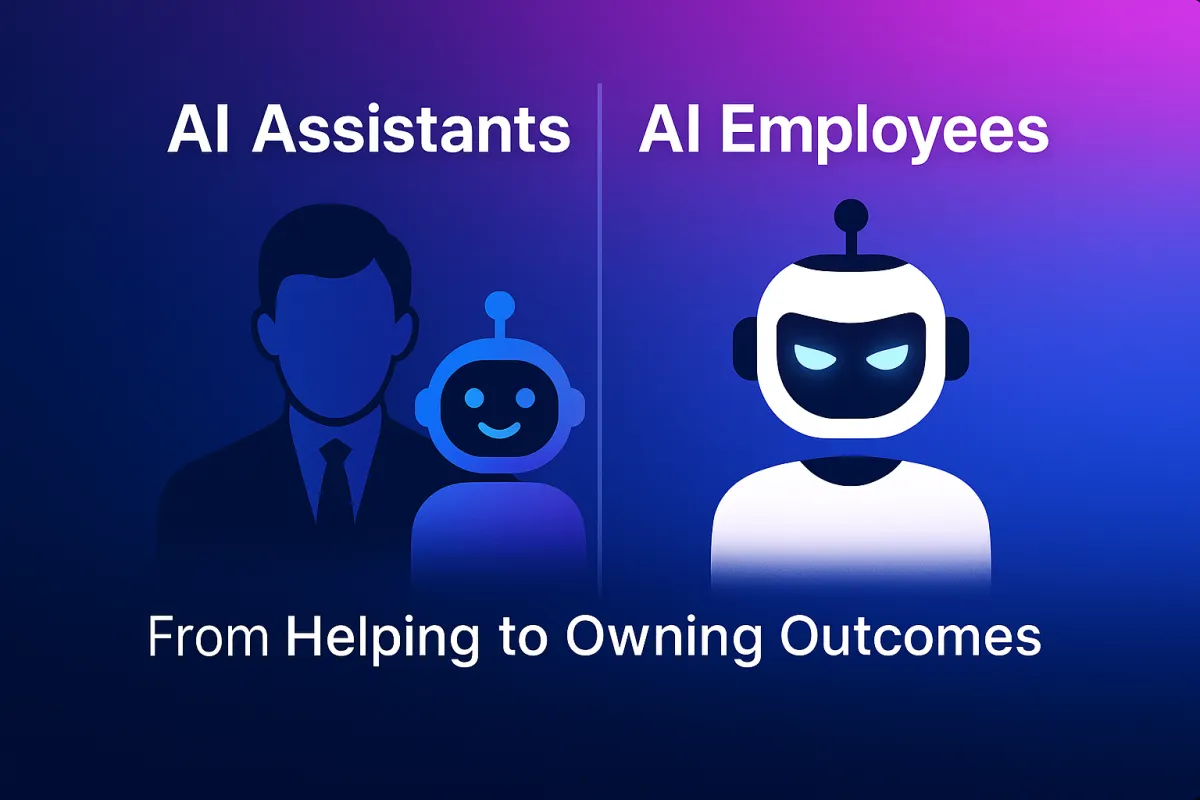
AI Assistants vs AI Employees: The Line Between Help and Ownership
AI Assistants vs AI Employees: The Line Between Help and Ownership
The AI revolution is no longer about chatbots that “assist.” It’s about agents that act.
But with that shift comes a critical distinction — between AI Assistants that help humans complete tasks and AI Employees that own outcomes end-to-end.
At AI Automated Solutions, we help South African businesses safely navigate this evolution — empowering automation that’s faster, smarter, and governed, not guesswork.
The difference isn’t just technical — it’s operational, ethical, and financial. It determines how your business delegates responsibility, manages risk, and measures success.
1. Role Design: Defining the Boundaries
Every AI system must start with a role definition.
Assistants support a person. Employees deliver an outcome.
For example:
A WhatsApp AI Assistant (via WhatsApp Marketing) might schedule reminders or answer FAQs.
An AI Employee could handle the full lead process: capture → qualify → quote → follow up — all logged in your InOne CRM.
The distinction helps teams stay aligned.
Assistants lighten human load. Employees own workflows.
2. Permissions: What They Can (and Can’t) Do
AI shouldn’t be given full control without clear boundaries.
That’s where permission layers come in — controlling what each agent can access, modify, or approve.
For example:
✅ Allowed: send WhatsApp follow-ups, create calendar invites, update CRM notes
🚫 Not Allowed: modify pricing, delete records, issue refunds
Inside your AI Automation module, these permissions are coded directly into each workflow — ensuring precision, compliance, and accountability.
3. Success Criteria: How to Measure Value
Unlike humans, AI doesn’t respond to praise — it responds to metrics.
Success criteria turn abstract automation into measurable impact.
For assistants, KPIs might include:
Response time
Message accuracy
User satisfaction
For AI Employees, they extend to business outcomes:
Conversion rates
Cost-per-lead improvement
Time-to-resolution reduction
Through Reporting & Analytics, every metric is captured, compared, and optimized — showing where AI delivers the most ROI.
4. Escalations: Knowing When to Hand Off
Even the smartest AI must know when to pass the baton.
That’s where handoff logic comes in.
Escalations happen when:
The AI’s confidence drops below a threshold
Sentiment or tone signals customer frustration
The query exceeds its authority (pricing, contracts, legal)
Your AI Callers and Chatbots are designed with built-in escalation pathways — instantly transferring the conversation or alerting a human team member in CRM.
That’s how automation stays safe — without sacrificing responsiveness.
5. Review Cadence: Continuous Improvement
AI systems aren’t “set and forget.” They need governance — weekly or monthly reviews to audit performance, accuracy, and brand alignment.
At AI Automated Solutions, we help teams establish a review cadence:
Weekly QA scorecards (accuracy, tone, resolution)
Monthly performance dashboards
Quarterly retraining and permission audits
These reviews ensure your AI workforce remains on-brand, compliant, and continuously improving.
Conclusion
The line between AI Assistants and AI Employees isn’t blurry — it’s strategic.
Assistants help humans move faster. Employees take full ownership of processes.
The smartest organizations design both, with clear scope, permissions, and oversight.
By defining roles, tracking outcomes, and maintaining governance, your business can safely evolve from AI-powered to AI-staffed — without ever losing human oversight.
🔗 Learn more: AI Automated Solutions
📞 Contact us: Contact Us

Close more deals,
with less effort
and gain data
Fast-Track Success with AI
Automate Mundane Tasks and Focus
on Building Your Business
with Ai Agency Cape Town.

